A hook is the first moment that gives the right viewer a reason to continue. It can be a sentence, image, action, sound or combination. Its job is not to trap everyone. Its job is to identify a relevant tension and promise a payoff the video can honestly deliver.
This distinction matters because exaggerated openings can increase initial attention while reducing trust, completion and qualified response. A durable hook is specific, legible and connected to proof.
Start with the viewer's decision
Before writing a line, complete this prompt:
The viewer is trying to decide or do ___, but ___ makes it difficult.
Examples:
- choose between two microphones, but reviews use different rooms;
- make text readable, but interface controls cover the lower frame;
- select music for a sponsored post, but library access is confused with commercial permission;
- improve a squat video, but the camera angle hides depth.
The blank creates useful tension without manufacturing drama. It also suggests the proof the viewer will need.
Choose a hook pattern that fits the evidence
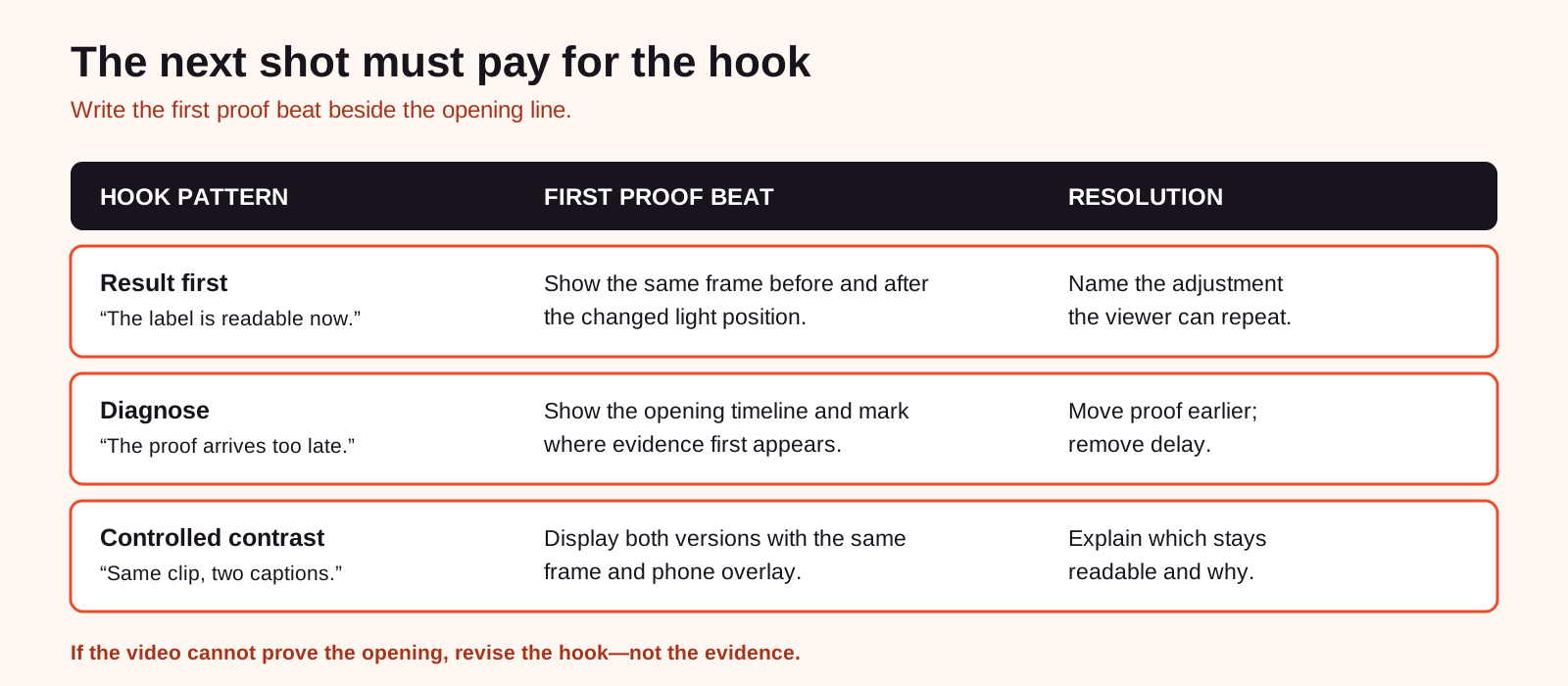
Result first
Show the outcome, then explain the change: “Same phone, but now the product label is readable.” Use this when the result is visually obvious and reproducible.
Problem diagnosis
Name a precise failure: “Your tutorial feels slow because the proof arrives after the explanation.” Use it when the video can demonstrate the causal link.
Controlled contrast
Hold variables constant: “Same clip, two caption positions.” Contrast works when the comparison is fair. State hidden differences if they matter.
Decision rule
Offer a boundary: “Use voiceover when the image needs explanation; use music-led editing when the action carries the meaning.” Decision hooks suit comparisons better than declaring one universal winner.
Open loop
Withhold one necessary step briefly: “The export was correct; this setting caused the crop.” Resolve it promptly. Do not stretch a small answer across the entire video.
Demonstration in progress
Begin with the action: plug in the cable, move the light or open the analytics view. This works when the subject is immediately recognizable. Add context before ambiguity becomes confusion.
Write three versions, not thirty
For each brief, write one result hook, one problem hook and one contrast or decision hook. Then score them:
| Test | Question |
|---|---|
| Relevance | Will the intended viewer recognize the problem? |
| Specificity | Does the line name an observable change? |
| Credibility | Can the video prove the claim? |
| Speed | Is the promise understandable immediately? |
| Fit | Does the tone match the creator and subject? |
| Safety | Does it avoid an unsupported guarantee or harmful shortcut? |
Select the strongest truthful option. Save the alternatives for a controlled retest only when the body still delivers the same promise.
Make picture, text and sound cooperate
Do not make all three channels repeat the same sentence. If speech explains “move the light sideways,” the image can show the movement and text can label “side light.” This gives each layer a role.
Test four previews:
- first frame only;
- first two seconds muted;
- audio only;
- full opening at phone size.
If muted viewing becomes misleading, add enough text or visual context. If audio-only makes no sense, check whether the image dependence is intentional. Captions must be accurate, but the creative text overlay can remain shorter than the spoken line.
TikTok's official business guidance emphasizes the beginning of a video and conversational scripting. Apply that principle without treating a fixed number of seconds as a universal law. A complex audience may need a little more orientation; a visible transformation may need none.
Connect the hook to the first proof beat
The biggest hook failure happens after the opening. The script promises a test, then spends time on biography or generic advice. Write the next shot beside the hook:
hook: “This caption is readable until the Reel interface appears.”
next proof: overlay the interface-safe preview and mark the collision.
The first proof beat should reduce uncertainty. Continue in a clear sequence until the promise is resolved. If the body cannot prove the hook, rewrite the hook—not the evidence.
Avoid seven common failures
- Universal claim: “This always doubles views.” Replace it with the actual observed context.
- Vague alarm: “You are doing this wrong.” Name the action and consequence.
- Delayed subject: the viewer waits to learn what the video concerns.
- Mismatch: a dramatic opening leads to ordinary, unrelated advice.
- Crowded first frame: face, headline, subtitles and product compete.
- Copied cadence: the words imitate a trend but do not fit the speaker.
- No resolution: the video asks for a follow before delivering the answer.
Hooks involving health, money, law, safety or platform rules need especially careful scope and sources. Urgency does not excuse an unsupported claim.
Test hooks with comparable evidence
Do not judge only by total plays. Review whether the intended audience stayed, whether the first meaningful drop occurs before proof, whether qualified responses increased, and whether the body delivered satisfaction.
When testing, keep the topic, proof, duration and publishing conditions as similar as practical. Change the hook pattern or first-frame composition, not every creative variable. Platforms distribute videos unevenly, so use several observations before declaring a pattern.
Maintain a hook log:
audience tension:
pattern:
exact opening:
first proof beat:
expected signal:
result:
interpretation:
next test:
Over time, build a library by audience problem and proof type, not by empty templates. “Show the hidden setting, then the corrected result” is reusable because it describes a mechanism. “Stop scrolling” is merely a phrase.
Final hook checklist
The intended viewer is identifiable. The promise is specific. The first frame is legible. The spoken claim survives fact-checking. The next shot begins the proof. The body resolves the promise. Captions and overlays do not compete. The hook does not rely on an irrelevant controversy, unsupported guarantee or rights-protected clip.
The best hook is an honest compression of the video's value. It earns attention by making the right problem clear and keeps attention by beginning the proof immediately.
Production Timeline