TikTok planning should make a video feel native without making your business dependent on improvisation. The solution is a lightweight brief: one audience tension, one opening, one proof sequence, one sound decision and one measurable next step. You can react quickly because the underlying decisions are already clear.
TikTok changes features and policies frequently. Verify current account, region, disclosure and music controls when posting. The process below separates durable editorial practice from platform-sensitive details.
Find a tension worth resolving
Start with what the viewer is trying to do, not what you want to announce. Useful tensions include:
- a result that looks easy but fails for a specific reason;
- two methods that appear equivalent but produce different outcomes;
- a common rule with an important exception;
- a decision people make without the necessary information;
- a process whose most valuable step is normally invisible.
Write the tension as a question. “Why do phone videos look flat beside a window?” is more productive than “make lighting content.” Collect questions from comments, support conversations, search suggestions and direct observation. TikTok Studio provides tools for content management, performance analysis and creative inspiration, but the tool does not decide which questions your expertise can answer responsibly.
Write three hook options
A hook is the first understandable promise, not simply the first sentence. Write alternatives before filming:
- Result: “This one change makes the labels readable.”
- Problem: “Your captions disappear here for a predictable reason.”
- Contrast: “Same light, same phone, different angle.”
TikTok's own creative guidance for advertising emphasizes the early seconds and recommends direct, conversational scripting. Treat that as a prompt to earn attention quickly, not as permission for unsupported claims. The opening must match the proof. If “always” or “never” makes the hook exciting but false, narrow it.
Test the hook at thumbnail size and without audio. Then play only the audio. The idea should survive both conditions, while the combined experience should be stronger.
Turn the answer into a shot sequence
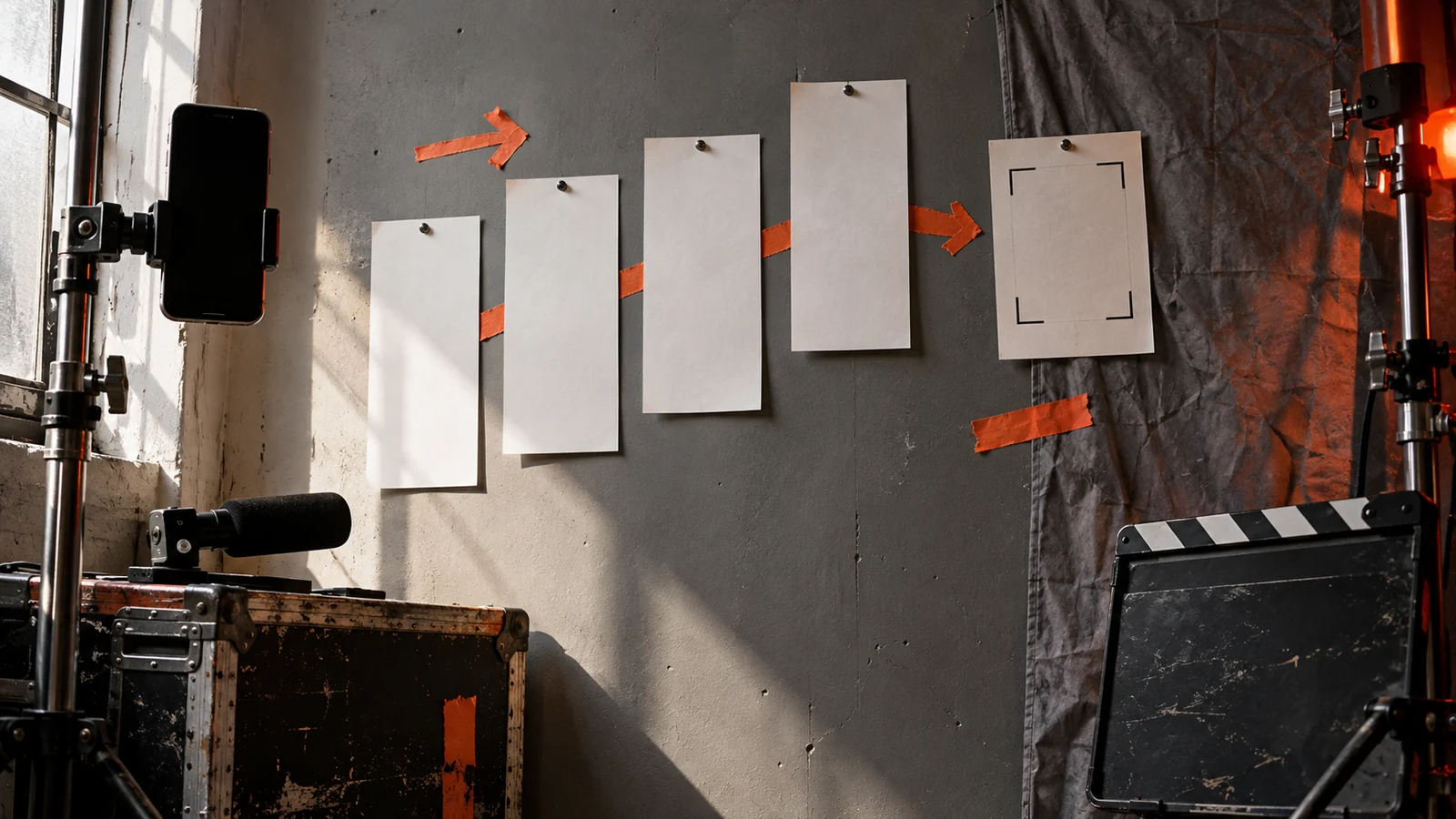
Plan shots with a verb and purpose:
| Beat | Purpose | Example |
|---|---|---|
| Open | expose the tension | show the failed label |
| Orient | give necessary context | identify the window direction |
| Demonstrate | change one variable | rotate the product |
| Verify | show the result | compare both frames |
| Close | state the usable rule | “turn, then expose” |
This is enough for many tutorial videos. Add beats only when they prevent misunderstanding. Capture the proof before decorative B-roll. Record room tone and clean voice separately if the environment is noisy.
Plan on-screen text as information architecture. Use it for names, sequence, numbers and words likely to be misheard. Do not transcribe every spoken word manually if accurate captions already provide that role. Check spelling and timing; automatic captions can turn a useful explanation into misinformation.
Choose sound with the commercial context known
Before browsing music, decide whether the post promotes a brand, product or service. TikTok recommends the Commercial Music Library for commercial content because the licenses for music outside that library do not cover commercial use in such content. Its current help guidance says that using original sound or music outside the CML with the disclosure setting requires confirmation that no protected music is present or that necessary licenses were obtained and paid for.
For a Business Account, TikTok's business documentation says the in-app sound picker shows Commercial Music Library tracks. Personal accounts may see a wider catalogue, but visibility is not proof of commercial permission.
Use this sound record:
asset / track:
source library:
account type:
intended use: organic / sponsored / paid
platform and territory:
license or confirmation evidence:
date checked:
clean-master location:
If the sound is not essential, build a version around intelligible voice, original effects or silence. A trend should not make the asset impossible to reuse lawfully.
Plan disclosure before the upload screen
TikTok requires creators to use its content-disclosure setting when a post promotes a brand, product or service under the relevant rules. Decide this during briefing, especially for gifts, affiliate relationships, sponsors and promotion of your own business. Also follow the advertising law that applies to your audience and location.
Place essential disclosure where viewers can perceive it and avoid contradicting it with the spoken message. Store the brief, approval, disclosure decision and final caption together. If a brand requests paid usage, Spark Ads or other amplification, confirm the contractual permissions and duration separately.
AI-generated or significantly edited realistic media requires another check. TikTok's current support guidance requires labels for realistic AI-generated images, audio or video in the circumstances it describes and offers creator and automatic labels. Record which elements were generated or altered and review the live policy before publishing.
Use a controlled posting package
Keep one folder or record containing:
- clean video master;
- TikTok export;
- cover frame;
- caption and disclosure text;
- source and fact-check notes;
- music or sound evidence;
- approval record;
- intended objective and review date.
Preview the post on the device used for publishing. Confirm crop, text, captions, volume, cover and disclosure controls. Open every destination. If the video contains time-sensitive platform instructions, add a review date rather than leaving it evergreen by default.
Read results without chasing noise
TikTok Studio exposes analytics such as views, follower change, likes and individual-post insights. Start with the video's assigned job. A discovery video should reach and retain suitable new viewers. A trust video should generate saves, qualified questions or profile exploration. A conversion post should be judged by the intended action and its quality.
Compare a group of similar posts, not one outlier. Keep a simple experiment log:
hypothesis:
controlled elements:
changed variable:
expected signal:
observation window:
result:
next decision:
Change one major element at a time: hook, proof order, duration, presenter or call to action. Repeating the same premise with a clearer opening is learning; reposting random trends is merely more output.
A 30-minute planning routine
Use ten minutes to select an audience question and verify the answer. Use ten to write three hooks and the proof sequence. Use five to decide sound, rights and disclosure. Use five to define the posting package and success signal. If the fact check or rights decision cannot fit, the idea is not ready for filming—schedule the missing work instead of guessing.
The result is a TikTok workflow that stays responsive while remaining auditable: real tension, honest hook, visible proof, purposeful sound, correct disclosure, clean assets and a written learning loop.