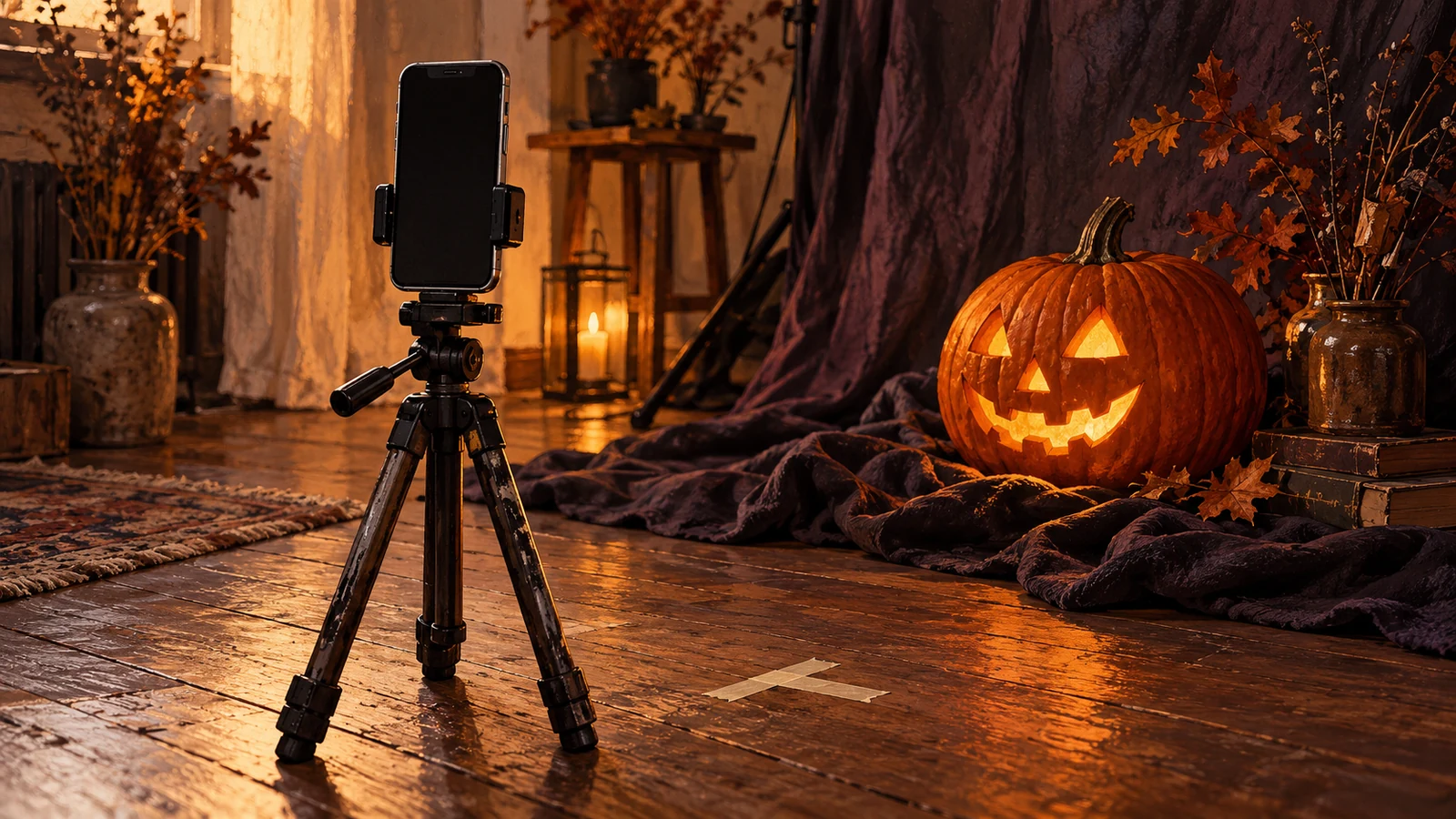
A Halloween hook should tell the viewer what is worth watching. A dark frame, a scream, and the word “wait” may create noise without giving the audience a useful reason to stay. Tie the opening to a specific reveal, method, or story question, then deliver that promise in the actual video.
Imagine a creator teaching a paper-ghost shadow effect. The most useful opening is not necessarily the most dramatic. “This ghost shadow uses one lamp and a paper cutout” tells viewers what they will learn. A brief finished-result shot can make the promise visible before the tutorial starts.
Choose the type of promise
Use a result promise when the outcome is the attraction, a method promise when the technique is the value, or a story question when the audience is watching fiction. Do not mix all three into a confusing first sentence.
| Hook type | Halloween example | Payoff required |
|---|---|---|
| Visible result | “A ghost moves across this wall without an animation.” | Show the practical setup and moving cutout |
| Useful constraint | “Make a costume reveal without moving the camera.” | Demonstrate the matched positions and cut |
| Correctable mistake | “Your spooky shot is dark because the face has no edge light.” | Compare the actual lighting change |
| Story question | “The pumpkin was on the left when I left the room.” | Establish its original position and reveal the change |
| Material substitution | “No fog machine? Try this layered shadow setup.” | Show the real alternative without faking fog |
These examples are editorial patterns, not performance predictions. Pick the promise your footage can prove. If the effect uses compositing, do not present it as an untouched practical trick.
Put evidence in the first frame
Start with the object, action, or comparison relevant to the promise. A title card that says “Halloween tutorial” takes time without clarifying what the viewer will learn. A split view showing a weak shadow and a clear shadow does more useful work.
Check the frame at the size people will actually see. The paper ghost must be large enough to identify; labels need room around the platform interface; the background should not bury the result. Dark atmosphere and unreadable information are different things.
For a fictional story, orient the audience quickly. Show the pumpkin and the doorway before changing the pumpkin's position. The viewer needs a known state to recognize that something strange happened.
Write three openings around one finished body
Keep the explanatory section identical and change one element of the opening. One version can show the result, another can state the constraint, and a third can name the common mistake. This makes the comparison more useful than rebuilding the entire video each time.
Record the variants consecutively while the setup is consistent. Keep similar framing, duration, and volume unless one of those is deliberately the variable. Save the clean opening takes separately so an editor can replace them without disturbing captions throughout the body.
Before publishing, check that every variation accurately describes the same outcome. “One lamp” is misleading if a second light was required to make the demonstration work. “No editing” is misleading if you used a hidden cut. Improve the wording instead of trying to hide the process.
Budget the suspense
Suspense needs a question and movement toward an answer. A repeated “just wait” does not add information. Use each beat to reveal a clue, remove an assumption, or show progress toward the technique.
For the paper-ghost tutorial, a practical order is finished shadow, cutout, light position, movement, then the full result. For the pumpkin story, use original position, a brief absence, changed position, and a final clue. The order differs because the audience is receiving a lesson in one case and a story in the other.
Avoid a loud startle as a substitute for a clear hook. A restrained sound, visible movement, or direct sentence can create interest while keeping the opening understandable at ordinary listening levels.
Review a hook using the right evidence
Watch the finished video with someone who has not seen the setup, if possible. Ask what they expect after the opening and whether the ending delivers it. That checks comprehension before you interpret analytics.
YouTube's retention documentation explains the platform's viewing-pattern reports. Use the reports available for your video to inspect an opening; some key-moment highlights require at least 60 seconds and 100 views. A drop does not prove one phrase caused the result. Different distribution and audience conditions can also affect a comparison.
Write the lesson narrowly: “The result-first opening made the technique easier to identify” is more useful than “Questions never work.” Keep the hook and its evidence together in your project notes. After Halloween, the same approach can help any video where the promise needs a visible, honest payoff.
Related guides
Sources
- YouTube Help — Measure Key Moments for Audience Retention — checked 3 October 2026.