A Halloween loop works when the return to the opening adds meaning. The pumpkin returns to its original position, a shadow repeats its route, or the same door opens on a new clue. Repetition should support the story rather than merely make the file restart without an obvious gap.
Try a simple fictional scene: a paper ghost rises behind a mug, the creator turns to inspect it, and the ghost drops out of sight. The creator reaches for the mug again, returning to the starting pose. The viewer can understand a small story in one pass and notice the setup when it repeats.
Choose a loop structure before filming
There are three useful approaches. A reset loop restores the original arrangement. A motion loop uses the same direction and speed at the start and end. A question loop ends on a clue that changes how the opening is read.
| Loop structure | Halloween example | Main continuity requirement |
|---|---|---|
| Reset | A ghost disappears and the mug returns to its starting mark | Objects and performer match the first frame |
| Motion | A bat silhouette moves across the edge of the frame again | Direction and movement speed align |
| Question | The last frame reveals who moved the pumpkin | The first frame still makes sense after the clue |
Choose one structure and write the required first and last states. A loop can fail even when the edit is technically seamless if the action becomes confusing. The viewer should understand what changed and why the scene returns.
Film the start and finish as a matched pair
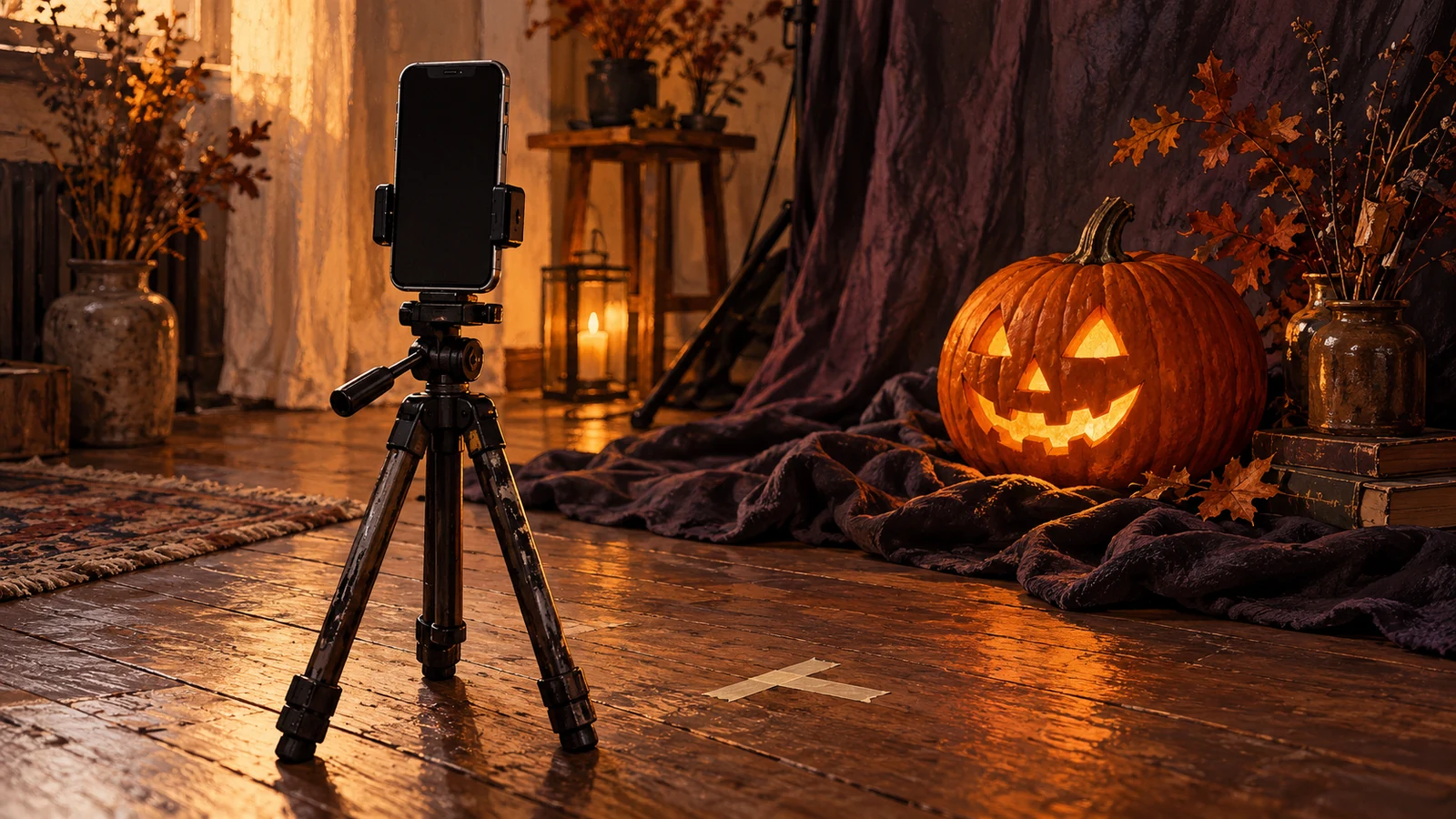
Take a reference photograph of the opening. Mark the mug, prop, feet, and camera position. Keep light direction and exposure consistent. Record a longer hold at both ends so you have choices when building the seam.
For the paper ghost, film the complete action in one stable frame where possible. The performer reaches for the mug, the ghost rises, the performer looks back, and the ghost drops. Continue recording until the performer has returned to the starting hand position.
If the performer cannot reset smoothly, capture a separate finishing take. Match the state before adding decorative effects. A dissolve may hide a small discrepancy, but it can also create a double-image ghost that was never part of the intended story.
Make the middle worth watching once
The loop needs a readable middle even for someone who never sees the restart. Show the ghost long enough to recognize it, then give the reaction time to make sense. Cutting out every pause can remove the cause-and-effect relationship.
Use a small progression: ordinary action, strange movement, inspection, reset. The prop does not have to become more extreme on every beat. A quiet change can be more understandable than a sequence of unrelated scares.
Do not conceal an instruction in a loop that runs too quickly to follow. If the piece teaches the mechanism, offer a separate clear demonstration or a supporting article. A narrative loop and an assembly tutorial have different information needs.
Build an audio seam separately
Listen across the restart several times. A sustained sound cut halfway through can create an audible jump even when the picture matches. Room tone or a deliberately repeating rhythm may provide a simpler seam than a long dramatic swell.
If music fits the scene, audition the seasonal STIS album linked below against the repeated playback, alongside original recordings or another licensed option. STIS is operated by Angry Media, the publisher of this site. Confirm permitted use for the actual destination and keep the license evidence with the project.
STIS spooky season halloween sounds
Match the musical phrase where practical, and avoid cutting a spoken word at the restart. If a crossfade is needed, listen for an unwanted volume build where the sounds overlap. Do not describe the result as guaranteed to increase retention; the loop is a creative choice whose effect depends on the audience and distribution.
Check the repeated experience
Play the export repeatedly at normal speed with sound, muted, and at a small display size. Watch for a prop jump, a caption that disappears before it can be read, and a change in brightness that becomes distracting through repetition.
W3C's flashing guidance specifically notes the importance of evaluating repeated content. Prefer steady lighting and controlled motion when creating a spooky loop. A short effect can become a repeated hazard once the file restarts.
Plan meaningful captions and essential visual description following W3C WAI's media guidance. If the ghost's movement is the only clue, identify it through an appropriate description rather than expecting every viewer to see it.
Keep the matching-frame reference and the clean audio bed in the project. The most useful lesson from the loop is the state planning: decide where the story begins, what changes, and how it returns before trying to conceal the final cut.
Related guides
Sources
- W3C WAI — Understanding Three Flashes or Below Threshold — checked 3 October 2026.
- W3C WAI — Making Audio and Video Media Accessible — checked 3 October 2026.